
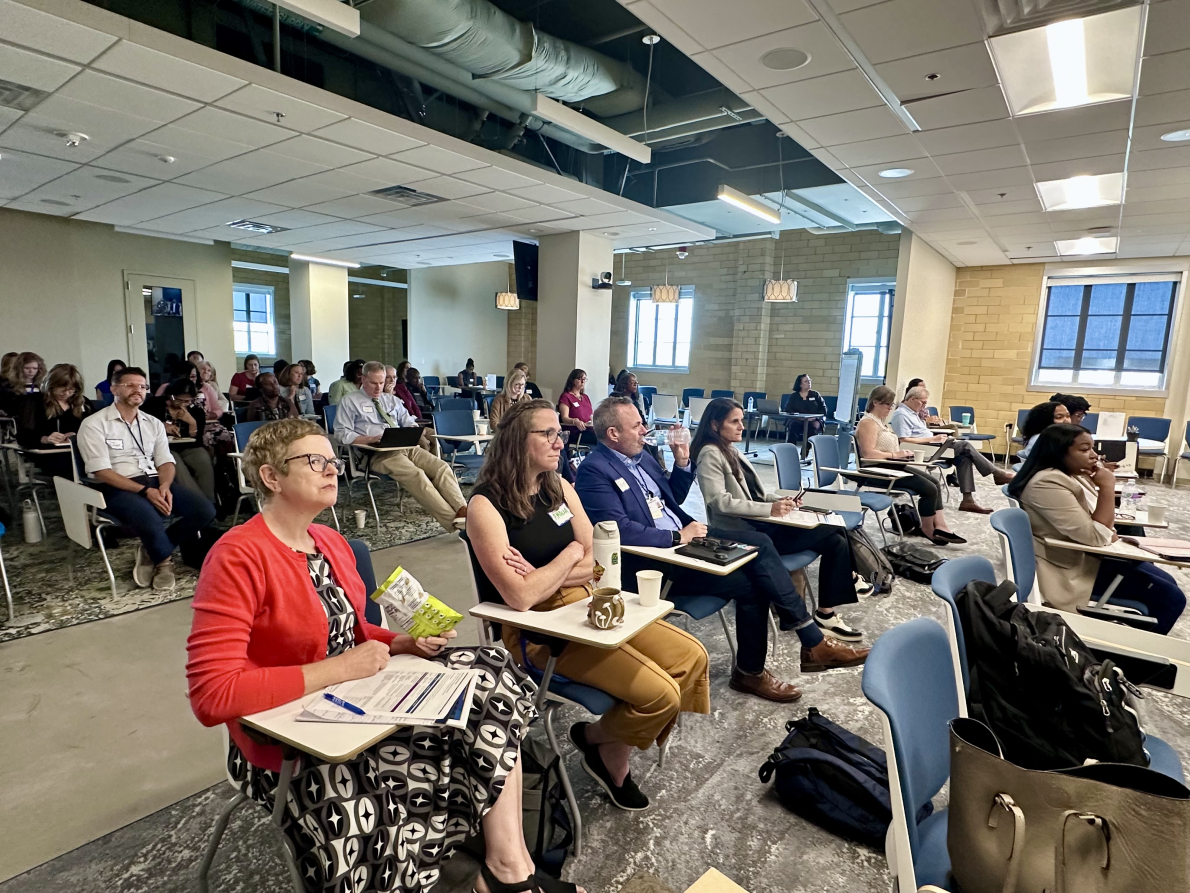
On September 18, the Duke University CTSA community gathered at the Chesterfield Building in downtown Durham for its annual retreat. The day focused on the theme, Rural Health as a Translational Science Priority. North Carolina has the second-largest rural population in the nation, and the CTSA has a dedicated rural health focus.
The message that emerged from presenters and community members alike was that improving rural health will require moving beyond traditional academic engagement toward genuine co-creation, shared decision-making, and relationship-building. The emphasis throughout the day was on showing up, listening, and contributing before asking communities to participate.
Framing the day
Opening remarks from Devon Noonan, PhD, MPH (Duke), and Deepak Kumar, PhD (NCCU), introduced the Translational Science Benefits Model as a framework for measuring real-world impact. They emphasized rural health not only as an area of need but also as an opportunity to advance translational science by building evidence in partnership with communities. The speakers also highlighted ongoing efforts, including NCCU's establishment of a Rural Health Hub in Enfield, North Carolina, and Duke's Rural Hub.
The morning continued with an overview of Rural Health Transformation and the Margolis Center's involvement from Rebecca Whitaker, PhD, MSPH. Christopher Lindsell, PhD, and Rishikesan Kamaleswaran, PhD, then presented examples of how artificial intelligence could support and advance rural health.
Hearing from the community
The community panel was among the most candid sessions of the day. Panelists Lisa Tyndall (Foundation for Health Leadership and Innovation), Henry Crews (Green Rural Redevelopment Organization), Rueben Blackwell (Rocky Mount Opportunities Industrialization Center), and Eric Cunningham, EdD (Halifax County Schools), detailed urgent unmet needs, including behavioral and maternal health services, clean water, housing, and lengthy school bus commutes.
A CTSA expert panel featuring Ranee Chatterjee Montgomery, MD, MPH, Kanecia Zimmerman, MD, PhD, MPH, Tracie Locklear, PhD (NCCU), and Crystal Lee Pow Jackson, PhD (NCCU), explored how to weave rural health priorities into CTSA programming and research. Discussion topics included building a homegrown workforce pipeline beginning in K-12 education, partnering with Duke's Primary Care Research Consortium clinics, and creating more opportunities for informal relationship-building with community partners.
From conversation to collaboration
During the afternoon Cross-Module Collaboration Café, five breakout groups developed concrete proposals, including using ethnodramas to build AI literacy, training community members as pilot reviewers, supporting barbershop-based health education, and creating an "NC Chatter" platform to connect researchers and communities.
One statistic stood out: only 17% of Duke's research participants are rural, compared with 35-40% of North Carolina's population. In response, participants committed to including more explicit rural-health language in future funding announcements and identifying new ways to engage rural residents in research.
Looking ahead
The retreat concluded with three leadership-endorsed commitments for Year 2 of the CTSA:
- Rural site visits: CTSA leadership, led by CTSI director Susanna Naggie, MD, MHS, will make in-person visits to rural partners in Halifax County and the Granville-Vance region.
- Urban-Rural Alliance: Development of a cross-institutional network of research professionals, faculty, educators, and community providers, paired with state-level advocacy for rural broadband.
- Expanded educational pathways: Growth of K-12 through community college programming to strengthen the rural health workforce.
Reflecting on the day's discussions, Kumar noted that the goal is not simply to bring more research into rural communities but to build the relationships and infrastructure needed for communities and researchers to identify priorities together, co-design solutions, learn from what works, and sustain those partnerships over time.
Noonan said the retreat's momentum signaled "a clear call to action" to address rural health with greater intention across North Carolina and beyond. The conversations reinforced the importance of positioning rural health as a translational science priority and centering community needs through a commitment to "showing up and listening to learn first."
2026 Duke University CTSA Retreat
-
 Devon Noonan, PhD, MPH, Deepak Kumar, PhD, Lisa Tyndall, Rueben Blackwell, Eric Cunningham, EdD, and Henry Crews.
-
 Tracie Locklear, PhD, Crystal Lee Pow Jackson, PhD, Kanecia Zimmerman, MD, PhD, MPH, and Ranee Chatterjee Montgomery, MD, MPH
-
 Attendees discuss ideas during the Cross-Module Collaboration Café.