
Just weeks after North Carolina’s first confirmed COVID-19 case in 2020, scientists from Duke University, the University of North Carolina at Chapel Hill, and East Carolina University were planning what would become one of the state’s earliest large-scale COVID-19 surveillance studies. Their results were published in October 2025 in PLOS One .
“It felt like we were building the plane while flying it,” said Carla Kingsbury, the lead clinical research coordinator at Duke. “There wasn’t time for the usual layers of planning—you just had to move.”
Funded by the North Carolina Department of Health and Human Services, the project began with a call from Duke infectious disease expert Chris Woods, MD, Wolfgang Joklik Distinguished Professor of Global Health, and principal investigator Kristin Newby, MD, professor of medicine. Their goal: launch a statewide research effort that could track infections and antibody responses in real time.
Within six weeks of receiving funding and three months after the first person in North Carolina was diagnosed with COVID, the team enrolled their first participant.
The study spanned multiple counties and academic hubs. Duke covered Cabarrus County through its Kannapolis site, UNC led efforts in Chatham County, and East Carolina University oversaw Pitt County. Together, the three institutions created a patchwork surveillance system capturing snapshots of the virus across distinct North Carolina communities.
While not statewide, the structure offered crucial diversity — urban and rural, east and west regionality, higher and lower income.
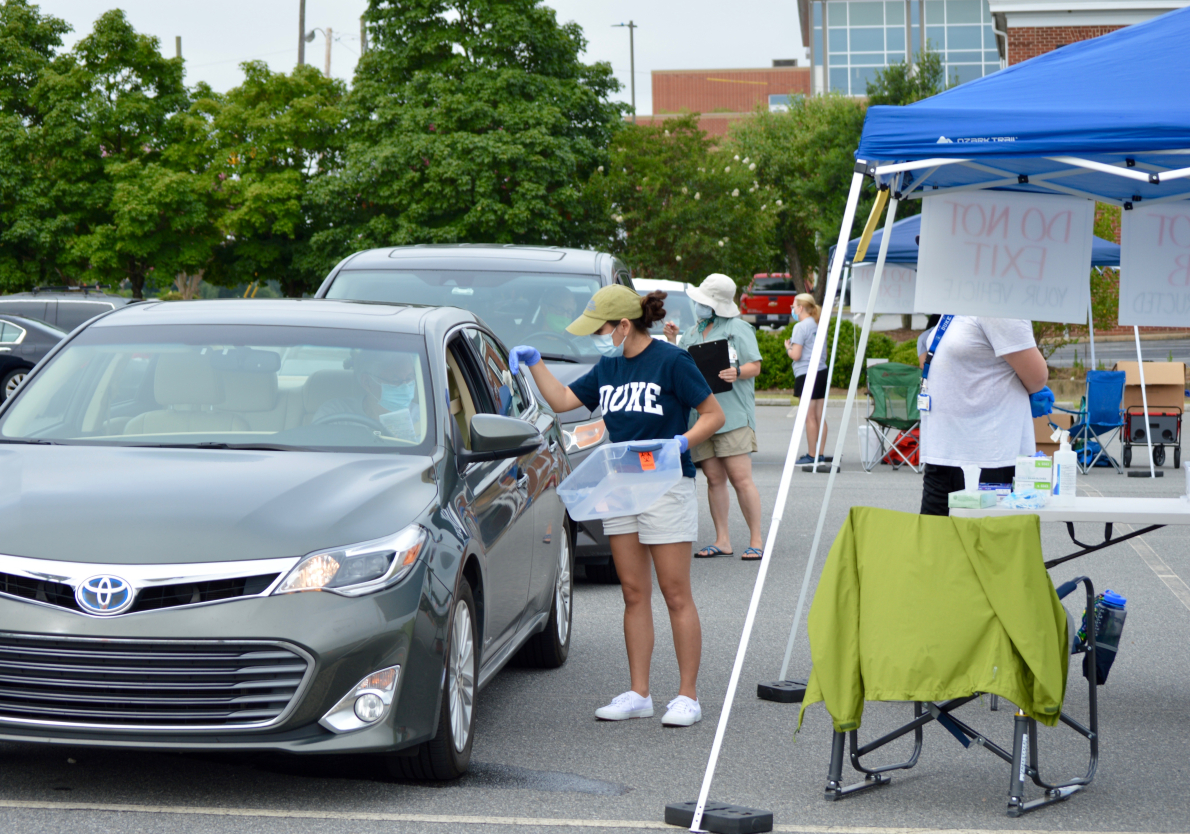
But they had to come up with a way to collect samples and still keep researchers and participants safe in a time of social distancing, so under tents in an empty bank parking lot next to the Kannapolis site, the team set up shop.
Researchers, equipped with cooling fans around necks and in full protective gear, enrolled participants and collected their first nasal swabs — all without participants having to leave their car. Participants were also instructed on how to obtain their own samples for the home kits that were given to them to complete every two weeks. The drive-through setup was a logistical feat that embodied the creativity demanded by pandemic-era science.
“It was over 90 degrees, masks and gowns, rain or shine,” Kingsbury said. “But it worked. And people showed up.”
That flexibility paid off. Duke ultimately enrolled 1,400 participants, the highest total among the participating institutions. The site also achieved the greatest diversity among participants, thanks to intentional community outreach through the MURDOCK Study Community Registry and Biorepository.
Participants were divided into sub-cohorts. Some performed biweekly nasal swabs to test for active infection, while others provided monthly blood samples to track antibody development. The result was a steady stream of data showing not just who was infected, but how immunity evolved over time.
Samples were sent to the North Carolina State Laboratory. Results came back every two weeks for swabs and monthly for serology tests. This allowed participants to receive results and feedback as part of the study.
“It wasn’t just about the data,” Kingsbury said. “People were using their results to decide whether to visit their parents, socialize with friends, or travel. It gave them a sense of control at a time when there was very little of that.”
Behind the scenes, the project was controlled chaos. The same handful of staff who managed the outdoor testing also handled blood draws, data entry, participant communication, all while maintaining adherence to Duke’s COVID research protocols.
“It took flexibility and teamwork,” Kingsbury said, “to coordinate every aspect of the study with fewer staff and stricter safety protocols, all while ensuring high-quality samples and data collection to support the study’s goals.”
But those challenges led to innovation. Many of the procedures developed on the fly — like remote consent, drive-through enrollment, and self-collected testing — became blueprints for later decentralized research models.
Flexibility wasn’t just a practical skill; it was an emotional one. Researchers and participants alike were living through the same anxieties and uncertainties. That shared experience, the team said, fostered empathy and strengthened connections, exemplifying community-engaged research at Duke.
“It was a stressful time, but we were reunited by the feeling that we were doing something that mattered,” Kingsbury said.