

A Translational Science Benefits Model Case Study
Program in a Nutshell
Given recent successful developments in treatment for early-stage Alzheimer’s disease (AD), there is a need for tests that allow early diagnosis and prognosis assessment. Shih-Hsiu “Jerry” Wang, MD, PhD, and Bin Xu, PhD, partnered to conduct research to develop minimally invasive tests for earlier AD diagnosis and monitoring disease severity.
Significance of the Program
Alzheimer’s disease, a neurodegenerative disease that affects memory and other cognitive functions, is the leading cause of dementia and affects more than 7 million people in the U.S.1 Recent developments for AD treatment work by removing excess amyloids, or protein aggregates that can build up to form plaques that impede brain function, from the brain.2 These promising therapies require accurate early AD diagnosis; they are only effective in the early stages of AD and are ineffective for those with other types of dementia. However, current diagnostic methods primarily include brain tissue examination after death and, for living patients, highly invasive procedures or expensive imaging techniques.3,4 Minimally invasive AD tests that can diagnose disease earlier could support anti-amyloid therapy use and serve a wider population of patients.
Overarching Goals and Approach
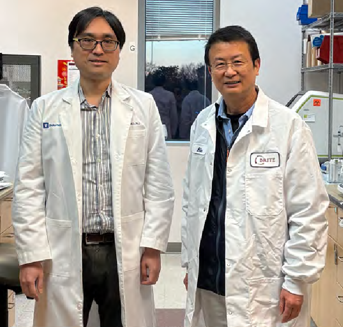
In 2021, Jerry Wang, MD, PhD, an associate professor of pathology at Duke University, and Dr. Bin Xu, a Principal Investigator at NC Central University’s Biomanufacturing Research Institute and Technology Enterprise and an associate professor of pharmaceutical sciences, started conducting research to develop minimally invasive tests (blood and cerebrospinal fluid [CSF]-based) for earlier AD diagnosis and monitoring disease severity.
Their work builds on the recent discovery of changes in tau proteins in the brain, wherein they misfold and are more likely to clump. This clumping leads to symptoms associated with various neurodegenerative diseases, including AD. However, current tests for these tau proteins can only be used on brain tissue from deceased patients to indicate if the patient was affected by AD or other neurodegenerative diseases (e.g., Pick’s disease or corticobasal degeneration) that also lead to dementia. Recent discoveries indicate that misfolded tau proteins can be found in the blood and CSF of living patients with AD, suggesting that early AD diagnosis is possible via identification and detection of AD-specific tau protein biomarkers.
Xu collaborates with Ling Wu, MD, PhD, a researcher based at NC Central who is also a Duke/ University of North Carolina (UNC) Alzheimer’s Disease Research Center (ADRC) Research Education Core (REC) Scholar. This team first identified several potentially AD-specific tau protein biomarkers through experiments wherein they examined brain tissue from deceased individuals with and without AD. 5,6 Next, Dr. Wang’s team validated these biomarkers by training machine learning software to recognize misfolded tau proteins. Wang and Xu were able to demonstrate that these biomarkers can be used to differentiate AD from other neurodegenerative diseases with similar tau protein behavior7 and to identify samples with AD-specific mild cognitive impairment, an early stage of AD where cognitive impairment does not interfere with day-to-day life yet.
In another study, Andy Liu, MD, MS, an associate professor of neurology at Duke, joined the joint research team to further examine whether one of these identified tau protein biomarkers was sufficient for diagnosing early-stage AD. 8 Using a laboratory test for this biomarker, CSF, and plasma samples from living patients, the joint research team demonstrated that this biomarker could differentiate early-stage AD from cognitively normal participants. However, more work is needed to differentiate early-stage AD from non-AD cognitive impairment.
This research program has led to several invention disclosures and Patent Cooperation Treaty (PCT) applications, which support patent applications within the US and internationally. The joint research team is now validating ultra-sensitive minimally invasive tests they have developed to identify the presence of these biomarkers in early-stage AD. This work paves the way for earlier and cost-effective detection of AD, which will facilitate treatment.
Future Directions
Wang and Xu and other team members intend to expand their program to further target other related neurodegenerative diseases with misfolded tau proteins using methods from their current research. Thus far, this expanded work has yielded a provisional patent for new biomarkers for a related neurodegenerative disease. This has the potential to lead to a broad panel of tests that can more accurately diagnose AD and its stages, as well as other related neurodegenerative diseases.
Facilitators of Success
Institutional Collaboration and Support
The collaboration between Duke and North Carolina Central University (NCCU), via the Duke-NCCU Collaborative Translational Research Grant, prompted collaboration between Wang and Xu. This institutional collaboration enabled easier access to patient samples, such as brain tissues and biofluids from the Duke/UNC ADRC and special laboratory instruments from NCCU’s Biomanufacturing Research Institute and Technology Enterprise (BRITE). Additionally, the geographic proximity of Duke and NCCU (approximately a 10 minute drive) further facilitated frequent sample sharing and lab work across campuses. With the addition of a Duke neurologist, Andy Liu, MD, MS, the joint research team was able to access important patient biospecimens (i.e., blood and CSF samples) via the Duke Department of Neurology’s Biospecimens Bank. Outside of institutional support, Liu also provided additional complementary expertise and a clinical practice perspective that benefited the joint research team. The collaboration was also facilitated by the project manager, Promila Pagadala, a staff member in the Duke Clinical and Translational Science Institute (CTSI) Accelerator’s pilot program who provided support associated with the Duke-NCCU Collaborative Translational Research Grant.
Challenges and Learnings
Competitive research field
The field of AD research consists of many research teams competing for success across the US and Europe. Given this level of competition, and the typical lengthy timelines of AD research, it is likely that there are multiple teams researching the same subject or developing the same product at the same time.
To navigate this challenge, it was important for Wang and Xu’s relatively small team to be strategic and thoughtful in selecting which of their initially identified biomarkers were the best to pursue, or the most likely to be successful, for AD test development. Strategic decision making sets up their team to reach their desired outcomes in a relatively timely manner.
About the Team

Bin Xu, PhD
Principal Investigator
NC Central University

Shih-Hsiu Jerry Wang, MD, PhD
Principal Investigator
Duke University

Andy Liu, MD
Co-Investigator
Duke University

Ling Wu, MD, PhD
Co-Investigator
NC Central University

Promila Pagadala, PhD
Project Manager
Duke University

Undi Hoffler, PhD
Technology Transfer Officer
NC Central University
Student and Trainee Personnel

Hibat Gindeel
Graduate Student Trainee
NC Central University

Tobilola Akingbade
Graduate Student Trainee
NC Central University

Fares Abu Sweilem
Undergraduate Student Trainee
NC Central University
Program Milestones
| Date | Milestone | Description |
|---|---|---|
| JUL 2016 | Funding | Bin Xu, PhD, received a grant from the Commonwealth Health Research Board of Virginia to study amyloids as a contributor to AD. |
| JAN 2017 | Preliminary Research | Xu’s lab began working on tau proteins, including research on skin biomarkers. |
| JUL 2027 | Funding | Xu & Ling Wu, MD, PhD, received awards from the Commonwealth of Virginia’s Alzheimer’s and Related Diseases Research Award Fund. |
| FEB 2019 | Funding | Xu was awarded an NIH R03 grant to study the effects of a potential treatment for amyloid-related diabetic complications associated with neurobehavioral deficits. |
| AUG 2019 | Lab Move | Xu’s lab moved from Virginia Tech to the BRITE Institute of North Carolina Central University to expand translational neurodegeneration work. |
| MAY 2020 | Funding | Xu was awarded the Biomarkers Across Neurodegenerative Diseases Grant from the Alzheimer’s Association, the Alzheimer’s Research UK, the Michael J. Fox Foundation for Parkinson’s Research, and the Weston Brain Institute. |
| OCT 2020 | Collaboration | Xu and Shih-Hsiu Jerry Wang, MD, PhD, decided to collaborate and applied for Duke-NCCU Collaborative Translational Research Grant. |
| JAN 2021 | Funding | Xu was awarded the Diabetes Action Research and Education Foundation Grant to study a potential amyloid inhibitor. |
| JUN 2021 | Collaboration | Andy Liu, MD, a neurologist, joined the joint research team. |
| JUL 2021 | Program start | The beginning date of the research program. |
| JUL 2021 | Funding | Wang and Xu were awarded the Duke-NCCU Collaborative Translational Research Grant to conduct initial research. |
| AUG 2021 | Intellectual Property | Filed an invention disclosure for tau protein biomarkers. |
| SEP 2021 | Funding | Xu was awarded an NIH R01 grant to continue working on tau protein biomarkers for AD diagnosis. |
| SEP 2021 | Funding | Wang was awarded an NIH P30 grant to further support access to blood, CSF, brain, and eye tissue and facilitate AD diagnosis and related research. |
| APR 2022 | Funding | Wu received the Duke/UNC Alzheimer’s Disease Research Center REC Scholar Award |
| MAY 2022 | Intellectual Property | Filed additional invention disclosures for tau protein biomarkers. |
| JUL 2022 | Publications | First paper from research program published in Frontiers in Aging Neuroscience. |
| NOV 2022 | Intellectual Property | Filed a provisional patent for tau protein biomarkers. |
| JUL 2023 | Conference | Presented 3 abstracts at the Alzheimer’s Association International Conference |
| JUL 2023 | Funding | Wang and Xu were awarded the North Carolina Biotech Center Translational Grant Award. |
| FEB 2024 | Funding | Wu was awarded an NIH R03 grant to support a small research program focused on further development and validation of tau protein biomarkers for early AD diagnosis. |
| JAN 2025 | Funding | Wang and Xu were awarded a Duke-NCCU Collaborative Translational Research Supplemental Award. |
| APR 2025 | Intellectual Property | The team filed a provisional patient for new biomarkers for a related neurodegenerative disease. |
| APR 2025 | Intellectual Property | Patent Cooperation Treaty (PCT) application submitted for the US. |
| MAY 2025 | Intellectual Property | Patent Cooperation Treaty application submitted for Europe. |
DiagnosticProcedures: The joint research team is in the process of validating the tests they have developed. Once they are determined effective, they will allow early diagnosis of AD. (Potential)
Biomedical Technology: The tests being developed by the joint research team are new biomedical technology. (Potential)
Clinical Innovation Access: Earlier AD diagnosis provided through these tests will facilitate patients’ access to new anti-amyloid therapies that require early diagnosis to be effective. (Potential)
Patents: The joint research team has filed several invention disclosures and a provisional patent on tau protein biomarkers. (Demonstrated)
Cost Savings: Since these tests are minimally invasive and do not require large equipment, they will be less expensive for patients. (Potential)
Health Care Accessibility: As the tests being developed are minimally invasive and do not require large equipment, they will be less expensive and capable of being conducted in smaller clinics. This will increase access to AD diagnosis and testing, especially for those in rural or otherwise under- resourced areas. (Potential)
Health Care Delivery: These tests will improve health care delivery as they will enable AD diagnosis and prognosis for those in under-resourced areas. (Potential)
Health Care Quality: These tests will improve health care quality by providing AD diagnosis and prognosis earlier than the current methods. This will allow patients to receive AD treatments sooner. (Potential)
Life Expectancy & Quality of Life: These tests will provide earlier and more accessible AD diagnosis and prognosis to patients. This has the potential to improve quality of life through facilitating earlier AD treatments. (Potential)
Other Benefit Indicators
Developing the Workforce
The research provided an opportunity for Ling Wu, MD, PhD, a junior research faculty at BRITE of NCCU, for further career development. Wu recently won a special R03 grant in 2024 to support a small research program for the next generation of researchers in AD/Alzheimer’s Disease and Related Dementias research. This research also provided support and mentorship to multiple graduate and undergraduate students at NCCU such as those listed earlier as trainees in the research team, which promotes excellence in the clinical and translational research workforce.
Improving Health for All
Accessible, minimally-invasive tests facilitating early AD diagnosis and prognosis will be helpful in reducing disparities for patients who are not able to fully describe their symptoms due to the cognitive effects of early-stage AD. As these tests are minimally invasive and don’t require large equipment, they will be less expensive and able to be conducted in smaller clinics. As such, these tests have the potential to increase access to AD testing for those in rural areas, those without access to memory disorder specialists, and others without resources to obtain more expensive/invasive testing.
Resources
CTSI Resources Used
- From Duke CTSI Accelerator’s pilot program, the research team received the Duke-NCCU Collaborative Translational Research Grant. The collaboration between Wang and Xu and related team building were greatly facilitated and consolidated by this award.
- CTSI project manager Promila Pagadala provided project management related to this award and also helped the joint research team obtain additional funding (e.g., NCBiotech grant).
Other Institutional Resources Used
- AD, early-stage AD, non-AD, and rare tauopathy brain tissues access
- Case Western Reserve University Alzheimer’s Disease ResearchCenter
- Case Human Tissue Procurement Facility
- Duke/UNC Alzheimer’s Disease Research Center
- Bryan Brain Bank and Biorepository; Duke Department of Neurology Biospecimens Bank
- CN, early-stage AD, and AD dementia plasma and CSF access
- Bryan Brain Bank and Biorepository
- Duke Department of Neurology Biospecimens Bank
- Quanterix Simoa HD-X Automated Immunoassay Analyzer access: Duke Molecular Physiology Institute Molecular Genomics Core
- Quanterix Simoa SR-X Biomarker Detection System: NCCU’s BRITE (Xu Lab)
- Instrument access
- NCCU’s Biomanufacturing Research Institute and Technology Enterprise
- Virginia Tech Center for Drug Discovery
More Information
References (including *AD Research Program Products)
- 2025 Alzheimer’s Disease Facts and Figures. Alzheimer’s Association; 2025. Accessed September 22, 2025. https://www.alz.org/getmedia/ef8f48f9-ad36-48ea-87f9-b74034635c1e/alzheimers-facts-and-figures.pdf
- Self WK, Holtzman DM. Emerging diagnostics and therapeutics for Alzheimer disease. Nat Med. 2023;29(9):2187-2199. doi:10.1038/s41591-023-02505-2
- Chen-Plotkin AS, Albin R, Alcalay R, et al. Finding useful biomarkers for Parkinson’s disease. Sci TranslMed. 2018;10(454):eaam6003. doi:10.1126/scitranslmed.aam6003
- Dickson DW. Neuropathology of non-Alzheimer degenerative disorders. Int J Clin Exp Pathol. 2010;3(1):1-23.
- *Wu L, Gilyazova N, Ervin JF, Wang SHJ, Xu B. Site-specific phospho-tau aggregation-based biomarker discovery for AD diagnosis and differentiation. ACS Chem Neurosci. 2022;13(23):3281-3290. doi:10.1021/acschemneuro.2c00342
- *Wang Z, Wu L, Gerasimenko M, et al. Seeding activity of skin misfolded tau as a biomarker for tauopathies. Mol Neurodegener. 2024;19(1):92. doi:10.1186/s13024-024-00781-1
- *Wu L, Wang Z, Lad S, et al. Selective detection of misfolded tau from postmortem Alzheimer’s disease brains. Front Aging Neurosci. 2022;14:945875. doi:10.3389/fnagi.2022.945875
- *Wu L, Arvai S, Wang SHJ, Liu AJ, Xu B. Differential diagnosis of mild cognitive impairment of Alzheimer’s disease by Simoa p-tau181 measurements with matching plasma and CSF. Front Mol Neurosci. 2024;16. doi:10.3389/fnmol.2023.1288930
Additional AD Research Program Products
New biomarker could help diagnose Alzheimer’s disease early. EurekAlert!. https://www.eurekalert. org/news-releases/970188 . November 9, 2022. Accessed September 22, 2025.
Tau biomarker in Alzheimer’s disease may aid earlier diagnosis. Inside Precision Medicine . https:// www.insideprecisionmedicine.com/news-and-features/tau-biomarker-in-alzheimers-disease-may-aid-earlier-diagnosis/ . November 9, 2022. Accessed September 22, 2025.
Velander P, Wu L, Hildreth SB, et al. Catechol-containing compounds are a broad class of protein aggregation inhibitors: Redox state is a key determinant of the inhibitory activities. Pharmacological Research . 2022;184:106409. doi:10.1016/j.phrs.2022.106409
Conference Presentations
- Wang SHJ, Wu L, Ervin JF, Gilyazova N, Xu B. Detection of mild cognitive impairment of Alzheimer’s disease and tauopathy differentiation by phospho-tau396. Poster presented at: Alzheimer’s Association International Conference; July 16-20,2023; Amsterdam,NL. Accessed September 22, 2025. https://alz.confex.com/alz/2023/meetingapp.cgi/Paper/80248
- Wu L, Gilyazova N, Ervin JF, Wang SHJ, Xu B. New site-specific phospho-tau biomarkers discovery for Alzheimer’s early diagnosis and tauopathy differentiation. Poster presented at: Alzheimer’s Association International Conference; July 16-20,2023; Amsterdam,NL. Accessed September 22, 2025. https://alz.confex.com/alz/2023/meetingapp.cgi/Paper/80710
- Wu L, Gilyazova N, Ervin JF, Wang SHJ, Xu B. P-tau422: a novel biomarker for diagnosing mild cognitive impairment of Alzheimer’s disease. Poster presented at: Alzheimer’s Association International Conference; July 16-20,2023; Amsterdam,NL. Accessed September 22, 2025. https://alz.confex.com/alz/2023/meetingapp.cgi/Paper/80678
Invention disclosures
- 74408bbc - CSF-based ultrasensitive tests for Alzheimer’s disease diagnosis disease progression
- Site-specific phosphor-tau biomarker p-tau396 for Alzheimer’s disease and related tauopathy diagnosis and differentiation.
- Site-Specific Phosphor-Tau Biomarker p-tau198 for Alzheimer’s Disease and Related Tauopathy Diagnosis and Differentiation.
- Site-Specific Phosphor-Tau Biomarker p-tau212/214 for Alzheimer’s Disease and Related Tauopathy Diagnosis and Differentiation.
- Site-Specific Phosphor-Tau Biomarker p-tau422 for Alzheimer’s Disease and Related Tauopathy Diagnosis and Differentiation.
- Site-Specific Phosphor-Tau Biomarker p-tau262/263 for Diagnosing Mild Cognitive Impairment Stage of Alzheimer’s Disease from Cognitively Normal Case.
- Site-Specific Phospho-Tau Biomarker p-tau356 for Alzheimer’s Disease staging and early diagnosis.
© Duke Clinical & Translational Science Institute February 2026